Selected Essays
For Courses
The Monthly: July 2026
“Late Georgian match racing was never entirely about the horse. The horse mattered, obviously. It could win, lose, break down, refuse, bleed, collapse or immortalise a bloodline. But the social function of the thing extended well beyond athletics. Match racing was aristocratic theatre: gambling, reputation, masculine competition and dynastic signalling conducted through horseflesh.
Two centuries later, not much had changed, except the trust funds and accounting infrastructure.”
https://www.themonthly.com.au/july-2026/nation-reviewed/courses
Schrödinger’s Toothpick
There are objects so common that they become invisible. We notice the absence of our car keys, our wallet, our spectacles, our mobile phone or our dog. Nobody notices a toothpick.
This is a mistake.
The trouble with toothpicks is that they exist below the threshold of formal management but above the threshold of indifference. Nobody inventories toothpicks. Nobody audits them. No sensible person has a toothpick strategy. Yet, at the time of writing, I find myself responsible for a distributed toothpick network spanning multiple rooms of the house, operating under governance arrangements so informal that no one can accurately determine current inventory levels.
The issue emerged during what should have been an ordinary evening. A toothpick was believed to exist in the living room. Whether it actually existed remained uncertain. The subsequent investigation altered the evidence, and the situation deteriorated from there.
The original question was simple enough. Was there a toothpick in the living room?
This should not be a difficult question. The living room is not large, the number of toothpicks involved is modest, and the object itself is conspicuous enough that one might imagine its presence or absence could be established with reasonable confidence.
Unfortunately, the investigation immediately encountered methodological difficulties. During the search, a new toothpick was introduced into the system. At this point the original experiment was compromised. The original toothpick had never been directly observed; the replacement toothpick certainly had. Whether these were the same toothpick could no longer be determined.
The living-room toothpick now occupied a peculiar state. It both existed and did not exist.
I have chosen to call this phenomenon Schrödinger’s Toothpick. The scientific community has yet to respond.
Schrödinger’s cat, admittedly, faced higher stakes. Nevertheless, the underlying principle appears sound. The observer had altered the system. The act of looking had changed reality.
At this point a sensible person would have abandoned the inquiry. Instead, I found myself wondering how many toothpicks currently existed within the broader household.
This proved to be a more difficult question than expected. The kitchen contained toothpicks. The living room contained toothpicks. There was a non-zero probability of toothpicks elsewhere. What had appeared to be a single object was in fact a network.
The network had not been designed. It had emerged, like many successful systems, in response to a simple economic reality: at some point in the past, walking to another room had seemed slightly less attractive than obtaining another toothpick.
This is how human beings solve problems. This is also, incidentally, how empires begin. Not with ambition, but with convenience.
The Mongol Empire expanded because the pasture was full. The Toothpick Empire expanded because the kitchen was too far away.
One should not overstate the similarity. On the other hand, one should not ignore it.
The reader may feel we have wandered some distance from the toothpick. This is true. We shall return to it shortly, although this statement should not be interpreted as a guarantee.
Toothpicks, incidentally, are ancient. The Romans had them. The Japanese elevated them into craftsmanship. The wealthy once carried them in silver cases. Entire traditions of carving emerged around an object whose sole purpose was to remove a fragment of dinner from between two molars.
Human civilisation contains many mysteries. This is one of the more encouraging.
The Japanese, being apparently incapable of encountering a simple object without wondering how it might be perfected, produced toothpicks from boxwood, bamboo and ivory. The British, confronted with the same problem, generally appear to have concluded that a small stick would suffice. Entire national characters occasionally reveal themselves through such things.
At this point the reader may reasonably wonder what any of this has to do with the original toothpick.
This makes two of us.
Meanwhile, a separate issue had emerged. The bedroom remained a toothpick-free zone.
This policy was entirely self-imposed. No legislation exists, no enforcement mechanism has been established, and no inspections are conducted. Compliance nevertheless remains remarkably high. Political scientists should find this deeply disturbing.
The bedroom’s position has historically been one of armed neutrality. While recognising the legitimate need for toothpick movement throughout the wider household, it has consistently resisted permanent basing arrangements. The legal status of a toothpick transiting the bedroom en route to the ensuite remains controversial among scholars of customary household law. Permanent deployment, however, is prohibited.
Treaty obligations must be observed. Even when my wife is away. Especially when my wife is away.
The bulldog, who has contributed little to the investigation, remains unconcerned. His distant ancestors attached themselves to human camps tens of thousands of years ago, beginning a relationship that would eventually secure one of the most successful evolutionary outcomes in mammalian history. One of their descendants is currently asleep beside me.
The wolf conquered the world. The bulldog would simply like to know where his rug is.
These are sensible priorities.
Meanwhile, the original question remains unresolved. Was there a toothpick in the living room before I looked?
History is full of mysteries that cannot be answered. What did Alexander say at Issus? What did Caesar really think of Cicero? Did Richard III murder the Princes in the Tower?
To these enduring questions we may now add: was there a toothpick in the living room?
There is no way to know. The investigation altered the evidence, the treaty held, the bulldog fell asleep, and the bedroom remained demilitarised. Schrödinger’s Toothpick was never conclusively observed.
And there are now toothpicks everywhere.
I recommend that you consider them.
The Dog Suit
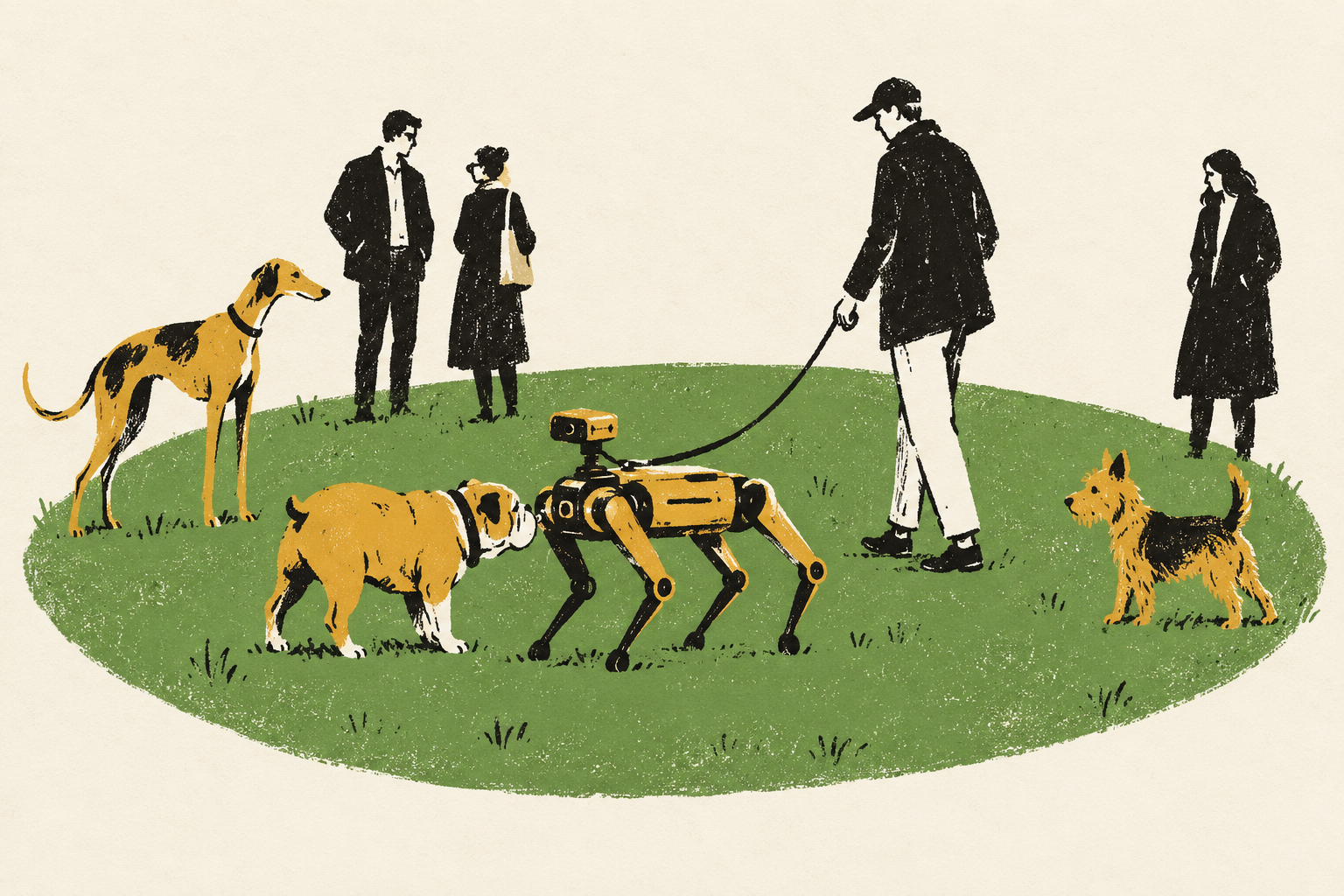
“Domestication is usually told as a story about us. We brought animals under control, the story goes; we selected, we shaped, we bent the wild to the plough and the hearth. It is a flattering account, and it is mostly backwards.
The animals we live with did not become safe to us because we learned to dominate them. They became safe because, over a very long time, two nervous systems adjusted to each other until each could read the other without violence. The dog is the oldest case and the clearest. No fence built the dog. No enclosure, no breeding programme at first, just proximity, and tolerance, and the slow sorting of an environment in which the animals that could read a human well enough to stay close without being struck were the animals that stayed. What got selected was not strength or obedience. It was the capacity to be legible, and to find us legible in return.”
A Day at the Picnic Races
I was twenty-two and I had driven up to Orange for a clinical rotation at the local veterinary clinic in my Scottish grandfather's chocolate Harris tweed. It was excellent tweed. It was not excellent weather planning.
By the week of the picnic races most of the district had already decided what it intended to wear, and most of those decisions were optimistic. The women planned hats first — wide brims for fine weather, felt if confidence deteriorated. The men assembled combinations of tweed, moleskins and polished boots entirely unsupported by available atmospheric evidence. Around the district a good many Driza-Bones stayed hanging in sheds, on the assumption they would not be socially required. They were required. By Friday everyone knew they were required, and wore the wrong thing anyway, because the right thing was not the point. The skies threatened all week and were widely ignored.
The horses arrived through drizzle the afternoon before, and I watched them come in, floats rolling into Orange carrying bush sprinters, ageing campaigners, difficult geldings and several animals whose owners still spoke about metropolitan form with touching optimism.
‘I think he’ll be a Group Three winner at Warwick Farm this year.’
Paddock runners often won the picnic races. This was not locally regarded as disqualifying.
The riders varied. Some were excellent horsemen. Some were fearless. The categories did not always overlap. A few of the jockeys were New Zealanders still in the district after shearing season and not yet returned to the Cambridge plains, and they rode with the relaxed fatalism of men long accustomed to livestock, weather and the occasional impact with the ground.
The racing was almost beside the point. That sounds dismissive and it isn’t. Everybody watched. Everybody bet. Owners cared desperately for approximately ninety seconds at a time. But the meeting was something larger than sport: it was the temporary assembly of a rural society, conducted publicly through weather, alcohol, horses and social obligation. Unlike a metropolitan meeting, where three-quarters of the crowd will drink straight through a Group One without interrupting the conversation, at Orange everybody stopped and watched. The betting paused, the marquees emptied, and for two minutes the meeting remembered the horses.
The old Orange families arrived early and behaved as though the weather were a minor administrative inconvenience rather than an atmospheric event. The horse people arrived behind floats smelling of hay, wet canvas and manure. Committee members moved between marquees carrying clipboards and the expressions of men with mounting private concerns. The women’s hats marked the first social separation of the day: the visitors persisted with optimistic millinery for a while before the local women transitioned, quietly and without comment, to felt and weatherproof pragmatism.
The rain set in properly mid-morning and did not seriously let up. Within the hour the high heels had begun their long descent into the mud while R.M. Williams boots moved across the same ground as though protected by separate agricultural legislation. The Sydneysiders had dressed in Mosman — sundresses, espadrilles — against a forecast they had preferred to the one that came, and were discovering the difference. The kegs and the champagne arrived simultaneously. Beer moved toward the public bar in aluminium rivers. Party pies and sausage rolls emerged from beneath steaming tea towels in quantities suggesting the committee had anticipated either a large crowd or a minor military campaign, and tomato sauce began to accumulate steadily across the district — on race books, on cuffs, on children, on at least one suede shoe whose future already looked uncertain.
The feta wraps went sadly unattended. Somewhere in the catering tent a well-meaning committee member had attempted to introduce a more contemporary culinary direction to the Central Tablelands picnic racing scene, and the district had rejected the proposal unanimously in favour of hot pastry, beer and gravitationally unstable sausage rolls. People imagine refinement changes human behaviour around free food. It does not. I have watched the Qantas business lounge descend into something resembling a frontier gold rush when the pies come out of the kitchen. Orange operated on the same principle, with less carpet.
The bookmakers worked from inexplicably large leather bags, with paper chits and alarming quantities of physical cash, looking less like financial professionals than travelling agricultural magicians moving portable liquidity between country towns. My beer had gone warm in the hand and I drank it anyway. The ground near the mounting yard, from where I stood in it, softened steadily. Men tested it with the side of a boot while pretending not to care. Someone from the committee was already worried about vehicles bogging after lunch, and was right to be.
And because this was 1986, and pre-mine Orange, the old names mattered and the old coats mattered and everyone already knew approximately who everybody was. Not perfectly. Just enough.
By mid-afternoon the district drifted toward the Calcutta, and I drifted with it, twenty-two and drenched through my grandfather’s Harris tweed, about to understand even less than I already did.
A Calcutta works like this, and I want to get it right this time, because I am not sure anyone at Orange ever did.
You buy a ticket. A draw — pure chance, no skill, no judgement — hands you a horse in the race. You might draw the favourite. You might draw Snitches. Then the room auctions your horse out from under you. Anyone can bid to take it, and if they do you keep half the price and walk away clean, the other half going into a pool. If you would rather keep the horse you drew, you may — but you buy it back at half price, because half of whatever it fetches goes to the pool regardless of who finishes up holding it. When the race is run, the pool pays out to whoever owns the placegetters. Sixty, twenty, ten, near enough, for first, second and third. Options, in other words, on an option of a bet.
Read that slowly and it almost stands up. You are not betting on a result. You are bidding to become the sole owner of somebody else’s luck, at a price the whole room watches you pay. It is the subprime mortgage crisis writ small — an instrument nobody present could actually price, traded with total confidence, and fine, completely fine, right up until the music stops. Then who the fuck knows.
That was the theory. The theory did not survive contact with Angus McCallum.
Angus was the stock and station agent, and he had done well for his clients at the recent cattle sales — everyone agreed on this, Angus first — which lent the proceedings a gravitational authority they had not otherwise earned. He ran the Calcutta the way he ran a yarding of weaners, in a full livestock cadence that admitted no gap into which a question might be inserted.
RIGHTOWHEREGOINNOWLOOKINGFORFIFTYFIFTYFIFTYWHO’LLGIVEMEONEHUNDREDNOWONEHUNDREDTHANKYOUSIRONEFIFTYONEFIFTYLOOKINGFORTWO—
Somewhere inside that noise the half-price buy-back was theoretically available. Nobody I spoke to had ever successfully exercised it. It required interrupting Angus, and Angus was not to be interrupted, and by the time you had established that this was the moment the horse had gone to a wheat farmer two rows back who may or may not have grasped that he now owned it. The pool arithmetic went the same way. It was, in principle, knowable. In practice it lived entirely inside Angus’s head, was audited by no one, and Angus was already three horses further on, and the beer had arrived.
Because that is the other half, the half the rules leave out. The heat. The beer. And the fact that what you had just paid was now public — a figure the room had heard, and would remember, and had already begun to read as a statement about your judgement, your confidence and your standing at the bank. Men bid against that reading rather than against the horse. I bid too — I am not certain I meant to; Angus’s cadence left no clean gap between listening and committing, and at some point I raised a hand, or was taken to have. At various points I believed I was purchasing part of a horse, exposure to a horse, a percentage of the possible future winnings of a horse, or potentially a disc plough. Private Chancellor, a bay, became briefly overcapitalised. Goolagoo, a plain brown, attracted quiet, knowing support. And Snitches — a flea-bitten grey — attracted a level of investment entirely unsupported by breeding, form or visible structural integrity, for reasons never established and that nobody, afterwards, would admit to.
I have since tried to understand Calcuttas properly. I hold a postgraduate qualification in statistics, and I have generally taken statistics as gospel. So I did the natural thing and built a model. It helped. To a point.
The naïve position values a holding at expected winnings — the pool multiplied by the horse’s probability of placing, less the price paid. This is wrong, and wrong instructively, because it assumes the horse is the asset. The horse is not the asset. The horse is one term in a system of at least six, none of them independent, and several of them drunk.
Let V be the true value of a position. Then, to a first approximation:
V = (P · p) − C + S − W − B − H
where P is the pool, p the probability of a placing, C the price paid, and the remaining terms are the corrections no metropolitan punter accounts for.
S is the social coefficient: the amount by which C, once spoken aloud and heard by the room, revalues you rather than the horse. S is large and positive if you underpay for something that runs, and large and negative if you are seen to overpay for Snitches. It is paid in standing, not cash, appears in no ledger, and therefore dominates.
W is the weather term, and W is not constant. It is a function of the going, which is a function of the drizzle, which was already falling when the pool closed and had not been priced by anyone, because the pool closed before lunch and the surface failed after it. W is, formally, the reason the whole thing is being solved at the wrong time.
B is beer, expressed as the accumulated blood-alcohol of the room, and it enters twice: once lowering the room’s discount rate, so that future winnings are valued as though present and certain, and once raising the variance on every bid, so that C detaches from p entirely. B is monotonic. B only ever goes up.
H is the millinery term. Negligible, I had assumed, until I noticed that the women who transitioned early to felt had also, quietly, stopped bidding, while the men still in optimistic tweed bid hardest. H is not causal. It is a proxy for the same optimism mispricing everything else, and it correlates with C at something north of 0.7 — higher than any term in the model involving an actual horse.
There should, at this point, be a further correction — a scratchings term, for horses withdrawn after settlement once the going turns and connections take a late, conservative view. I cannot specify it. A scratching does not lower p; it deletes p, and no continuous function survives a variable going to zero after the money is committed. The model loses its domain.
And the term obviates itself in any case, because Snitches ran. The one horse whose withdrawal the apparatus predicted with most confidence was the one horse that started — and a prediction that fails on its most certain case is not a prediction. That is the apparatus’s last word, and it tells you the apparatus was never the point. You have built something of some rigour around a shed of wet, optimistic, over-beered men who do not know it exists and would not care, and neither, supremely, does Snitches.
I assume somebody made money. I assume it was Angus.
Then, the going being what it was, the scratchings began.
This is the part metropolitan punters never quite believe. The Calcutta had already settled. The money was already committed, the shares already subdivided, the positions already defended loudly at the bar. And only then, with the surface deteriorating toward something between a bog and a billabong, did connections begin taking a conservative view of it. Queenstown Brave was withdrawn at the post — his owner had, sensibly and far too late, decided the horse was worth more unbroken than placed. Headway Girl followed, on the grounds that she had views about wet ground and had begun to share them. Two more went after her.
Which left a number of men holding substantial fractional positions in horses that were now standing in floats with their rugs on. Nobody called a lawyer. There was no mechanism for it and would have been no point. The shares in the non-runners were repriced by consensus at the bar, against a methodology that consisted largely of someone saying ‘well, he was never going to handle the wet,’ and everyone agreeing, including the men who had bid him up an hour earlier on precisely the opposite theory. A man near me was now, through no decision of his own, considerably more exposed to a horse that no longer existed as a racing proposition than he had ever intended to be. He took it well. There was nothing else to take.
The music had stopped. It was just that everyone was a few beers in by then, and nobody much cared — except Snitches, who was never going to be withdrawn on the advice of anyone sensible, there being no one sensible attached to Snitches, and who was therefore still, catastrophically, running.
By the time the survivors reached the mounting yard the district had become emotionally overcommitted to outcomes unsupported by any available evidence. Private Chancellor sweated heavily beneath his rug. Goolagoo looked, against all expectation, professional in the wet. A man at the rail explained at length that Snitches represented ‘overs,’ offering no coherent supporting methodology, to a listener who had stopped listening. Then everybody stopped talking, and turned to the track.
The barriers opened awkwardly. Mud flew immediately. A jockey lost an iron inside the first two hundred metres. And Angus, who ninety minutes earlier had sold the field to itself, climbed back onto substantially the same microphone and into full livestock cadence.
“ANDIT’SPRIVATECHANCELLORFROMGOOLAGOOWITHSNITCHESWORKINGTHROUGHONTHEINSIDE—”
Very little of it was individually intelligible. It did not matter. Somebody near the public bar screamed at Goolagoo with the emotional intensity normally reserved for maritime disasters. For about two minutes the entire district, myself among it, the tweed hanging off me by now like a wet sail and still unsure what I owned, was psychologically attached to a small field of wet horses and several increasingly unstable financial positions.
Goolagoo handled the going. Private Chancellor did not. Snitches appeared, briefly, capable of winning, before reverting to previously established personality traits and the inside rail. Then it was over, and immediately everybody began explaining why the result had always been inevitable.
The truing-up of the Calcutta resumed, now complicated by the non-runners, and appeared to involve cash, paper, partial ownership claims, the retrospective reinterpretation of earlier agreements, and several men wearing the expression of people reconciling a position in a horse that had never left the float. I did not attempt to follow the accounting. Most people drifted back to the bar, where a bookmaker stood alone recalculating figures in damp pencil and somebody explained, to no one in particular, that Goolagoo had ‘always wanted ground in it.’
By sunset the district had already begun converting the day into stories. The car park became a large-scale traction experiment in which R.M. Williams boots continued to function normally while urban footwear failed catastrophically, and utes towed stranded sedans out of the mud with quiet competence and only minimal visible satisfaction. The marquees came down in the drizzle, because there was a sheep show on the grounds the next morning, and the horses — those that had run and those that had wisely not — loaded quietly back into their floats.
In a few weeks the district would reconvene for the Molong CWA baking competition, and begin the whole business of assembling itself, in public, through weather and obligation, all over again.
Supermarket Aisle Genomics
“The weekly shop begins in the meat aisle, where genetics is behaving itself.
There is lamb in the trolley. Lamb is how inheritance is supposed to work. A sheep has two sets of chromosomes, one from each parent.
If you gave a lamb three complete sets of chromosomes, it would not take this well.
Then you leave the meat aisle and turn into fruit and vegetables.
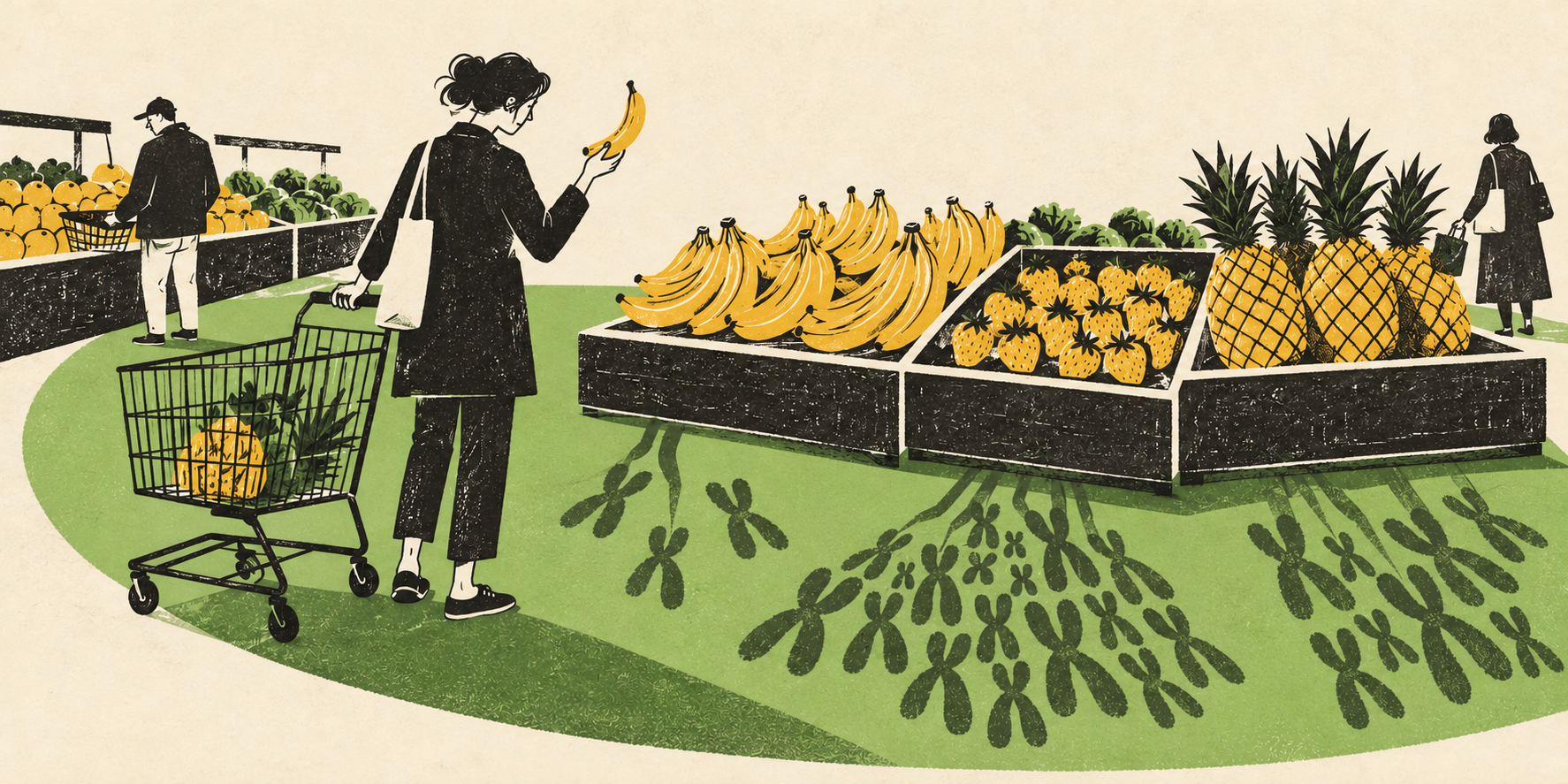
The first surprise is that plants do not share our sense of propriety. A startling number of the things in an ordinary supermarket are carrying extra whole sets of chromosomes. Others have abandoned sexual reproduction almost entirely. Some are sterile. Some make fruit without fertilisation. Some can make fruit only if a nearby plant, genetically more conventional than they are, performs the undignified but necessary task of pollination on their behalf.”
Roquet
Or: how four smart people, two regulation croquet sets, an asymmetric infrastructure, and an unbounded number of dogs survived the first lockdown
It was a regulation set. Six hoops, one peg, four balls in the proper sequence of blue, red, black, yellow. The mallets were full-length and the heads were properly weighted with brass hoops.
The lawn was the second thing to say, and the more important one. Peter and Elizabeth, four hundred kilometres north at their place near Lake Eucumbene, had built theirs from scratch. A purpose-laid regulation court, properly graded, properly mown, properly equipped. Ours, in South Gippsland, was the patch of grass behind the house. It had been the patch of grass behind the house before it was a croquet lawn and would be the patch of grass behind the house after. The hoops, set to regulation spacing, just fit, sort of, with the corner pegs about a metre from the fence line and the down court hoops unfortunately close to where one of the dogs liked to lie. The grass had been mown but not rolled. For one of the more contentious games, the Victorian centre peg was a young Horse Chestnut tree. The surface, in croquet terms, was unimproved.
This asymmetry mattered, because the four of us are smart, and smart people given a structurally unequal arrangement will leap on the inequality for an opportunity to argue.
A note on the cast, since the piece does not work without it. Elizabeth is a surgeon. In her professional life she is mild-mannered to the point of being almost unchallengeable, which is presumably part of the surgical bedside manner. Outside it, she is ridiculously competitive and tactically vicious. Peter is an economist. This means he proposed every elegant compromise that turned out, on inspection, to favour his end of the court. Michelle is a federal policy expert and the one who decides when the rest of us have lost the plot, which she does roughly once per jug. I am the vet. My role in the disputes was largely empirical: the tape measure, the spreadsheet, the photographic record. I also wrote it down later, which is how we end up here.
The premise was that we would play regulation croquet between the two lawns. Each shot would be filmed, called, measured by tape, recorded in a shared spreadsheet, and replicated at the other end. The MacBook sat on the patio table angled to cover both the keyboard and the lawn behind. Pimms was poured. The dogs assembled.
The disputes began on the first day and continued for the duration. The fundamental problem was scaling. If their court was regulation and ours was, by necessity, slightly smaller, then a stroke of four metres on their court traversed a different proportion of the playing field than a stroke of four metres on ours. Replicating the absolute distance produced different game states. Replicating the proportional distance produced different absolute measurements. The two ends of the connection were not, strictly speaking, playing the same game.
Zalzmaths Equation 1 — The Scaling Paradox (Sp).
A stroke of length L on a court of length C₁ is equivalent, under proportional rules, to a stroke of length L × (C₂/C₁) on a court of length C₂.
Under absolute rules, it is equivalent to a stroke of length L.
The two rule systems produce identical outcomes only when C₁ = C₂.
C₁ ≠ C₂.
Peter, by training, favoured proportional scaling, indexing if you like. He proposed a normalisation regime under which all strokes would be expressed as a percentage of court length and replicated proportionally at the receiving end. He defended it on welfare-economic grounds: the proportional system, he argued, equalised the players’ relationship to the field, which was the underlying intent of the regulations. Elizabeth, by training and disposition, objected. The proportional system, she pointed out, rewarded the smaller court for its own deficiency, which was an inversion of how regulations were normally meant to function. I countered, on grounds of empirical honesty, that the absolute system penalised the larger court for being larger, which seemed to punish Peter and Elizabeth for the labour of construction. Michelle, on grounds of practicality, suggested we just re-measure both ends and pour another Pimms. Michelle’s motion carried, as it almost always did. The dispute did not resolve. It merely recessed.
This was the texture of the games. Not “we played croquet, with disputes.” We ran a sustained mock-philosophical debate about regulation procedure, between two households, across four hundred kilometres of closed state border, using regulation croquet as the empirical material. The shots produced the data. The data was then fallen upon by four people with degrees and a willingness to argue at full intellectual stretch about the metaphysical status of a stroke that had been measured at 4.2 metres at one end and 4.0 metres at the other. The croquet was the substrate. The disputes were the entertainment.
I should be clear about how funny this was. It was, throughout, fucking hilarious. We knew it was ludicrous and we committed to the ludicrousness with full intellectual stretch because the disputes were funnier than the strokes. A bad shot was a bad shot. A bad shot followed by a forty-minute philosophical disagreement about whether the badness was a property of the stroke, the lawn, the wind, the operator, the metric, or the entire epistemological enterprise of replicating one lawn’s game on another lawn’s lawn — that was the actual sport. The croquet was the cover under which the disputes were permitted, nay encouraged.
The laser rangefinder appeared during the second tournament. Peter had “happened to find one” in the shed. It was, technically, a piece of survey equipment. It was also, technically, a violation of the rules we had agreed in the first tournament, which permitted only the tape measure. The fingerprints, on inspection, were Elizabeth’s. It was ruled unsporting on the day it appeared. By the third tournament, both ends had quietly acquired one. By the fourth, we had developed a convention by which their use was permitted only for measurements over five metres, on the grounds that for shorter distances the tape measure remained the more sociable instrument.
Zalzmaths Equation 2 — The Rangefinder Paradox (Rp).
Rp = Measurement Accuracy ÷ Social Trust.
The introduction of professional surveying equipment increased Rp’s numerator by approximately fourteen per cent and decreased its denominator by approximately the same margin. The system reaches equilibrium only when both ends have cheated equally. Equilibrium was, eventually, attained.
I want to be clear about the dogs, because the dogs were continuous. There were dogs throughout. The bulldog at our end stationed himself at the patio table whenever the MacBook came out, on the basis that the MacBook’s arrival usually coincided with the arrival of snacks. There were other dogs at our end too, lying in inconvenient positions on the lawn, and dogs of various ancestry at the Eucumbene end, including the one who would, at the appropriate moment, become important to the historical record. The dogs were not props. They were continuous variables. The mock-philosophical disputes had to incorporate them because they would not be legislated out.
Before any tournament, the lawns had to be walked. Polo, at the upper end of horse-adjacent spectacle, has divot-treading: linen-clad spectators wander onto the field at half-time to stamp down the turf the ponies have torn up, performing rural labour as ritual. There is an audience. There is champagne. The labour is theatre. Monaro croquet, played at our end at least, has the equivalent gesture, performed by the players themselves, before play, with a small bucket and a scoop. There is no audience. There is Pimms. The labour is genuine. The dogs have been on the lawn, and the lawn is also the court.
The pre-game walk did not, however, eliminate the in-game incident. During the second tournament, mid-stroke, with Elizabeth convening a procedural objection about the previous shot’s replication tolerance, one of the dogs — not a high-country dog this time, but ours — walked calmly to the third hoop, considered it briefly, and defaecated directly in front of it. Not on the line of measurement, not at the peg, not as tactical disruption. Right in front of the hoop, with the indifference of a creature that had not understood what the hoops were for or why their proximity would matter to anyone. The stroke that was about to be played was, by any reasonable definition, no longer playable.
The Doctrine of Canine Intervention, as it then stood, did not cover this. There was no clause for fresh deposition in the line of play. The four of us convened. Peter proposed, on welfare-economic grounds, that the stroke be replayed from a position equivalent to the one it would have occupied had the hoop not been compromised. Elizabeth objected: a hoop adjacent to fresh canine matter was not, structurally, the same hoop, and any replay would constitute a different game. I observed, on empirical grounds, that the hoop itself was unchanged; only its immediate environment had been altered. Michelle suggested, on practical grounds, that someone get a shovel. Michelle’s motion carried. Clause 7 was added to the Doctrine that evening.
Zalzmaths Equation 3 — The Doctrine of Canine Intervention (Ci).
Where a dog enters the line of measurement: replay.
Where a dog touches the ball: replay.
Where a dog removes the ball from the field of play: irrecoverable; result by mutual agreement. Or sent to tribunal.
Where a dog lies obstructing a hoop: pause until dog moves. Where dog refuses: hoop considered displaced; reset.
Where a dog is the cause of a stroke being missed: the stroke is replayed at the active end only, on the grounds that the dog is local and the lag is therefore inapplicable.
Where dogs at both ends intervene simultaneously: tournament suspended.
Where a dog defecates within the immediate playing zone of a hoop: pause; remediate; replay from original position. (Added retrospectively, Clause 7, second tournament.)
The Doctrine was developed iteratively, with subclauses added as new canine behaviours required them. There was no controlling authority. The four of us would propose a clause, debate it on the merits, ratify it by consensus, and Michelle would write it into the spreadsheet. Subsequent disputes about whether a particular dog event was covered by Clause 3 or Clause 5 were themselves entertainment. By the end of the second tournament the Doctrine was, in document length, longer than the actual rules of Association Croquet. None of us thought this was strange.
The dog incident worth recording happened during the third tournament, and it happened because of Elizabeth, which is to say because of who Elizabeth is. She was at the far hoop with a choice. One shot ran her own ball through to position and effectively closed out the game: the sensible line, the win. The other was a long, low-percentage roquet across the lawn at Michelle’s ball, which threatened nothing, cost her the position, and was worth precisely nothing on the scoreboard. We watched her consider both. There was a pause. Then the surgeon who is mild-mannered to the point of being unchallengeable all week looked at the winning line, ignored it, and set up for the roquet — because the win would keep, and the pleasure of hitting Michelle’s ball would not. This is the truest thing I know about Elizabeth. She would rather roquet you than win.
She struck it. And mid-stroke — the ball already running, the roquet already a half-second from connecting — one of the dogs at the northern end, a working breed of indeterminate ancestry whose entire moral position on croquet was that the balls were tennis balls and the tennis ball was a thing one fetched, walked calmly onto the court, picked up the blue ball, and ran off with it. We watched this happen at 1.2 seconds of remove. The bulldog, at our table in Victoria, registered the event with what looked like professional interest.
The Doctrine of Canine Intervention covered this. Clause 3: irrecoverable; result by mutual agreement. The blue ball was eventually recovered from somewhere near the woodpile, but by then the moment had passed. Elizabeth was furious. Elizabeth was furious in the way that mild-mannered surgeons are furious, which is more frightening than ordinary fury because it is silent and contained and looks like equanimity. Michelle suggested we close the laptops. We did. The result stood as a draw. The dog received no formal sanction; he was, after all, the only one of us who had registered any genuine surprise at the situation.
We played in person again last week. Peter and Elizabeth’s lawn near Lake Eucumbene, the proper one, the one that had been a small rectangle in the corner of a MacBook screen for the duration of the closed-border months and had now become a real piece of grass under real eucalypts with the lake visible behind it. The hoops were set to regulation spacing. The mallets were the same. We had Pimms. The wind was minor. The light at altitude was the light at altitude. Elizabeth was, as ever, in mild-mannered command of the day until she wasn’t.
The game took two hours. We won. Or they did. The result is no longer entirely the point, and the spreadsheet does not extend to in-person play, because in-person play does not require it. The measurements are the lawn itself. The roquets, when they came, were performed without ceremonial declaration, because in person you can simply hit your friend’s ball and let the satisfaction land directly, without the 1.2-second wait. Elizabeth, predictably, roqueted me twice.
It is worth saying, once, what the apparatus was for. None of us cared who won. The scaling paradox did not need solving and the Doctrine did not need writing. There was a closed border between two households who were, in every way the law recognised that year, not permitted to be together, and four people decided the border would not get to decide that. The croquet was the cover for the disputes, and the disputes were the cover for the fact that we were refusing to stop being a group when the state had ruled, we could not be one. The lawns were four hundred kilometres apart and we played on one lawn. We never said so, because saying so would have been worse than losing.
We are still playing. Internet Scrabble between the two households runs continuously, the in-person croquet now seasonal. A proposal for internet snooker remains under discussion. The technical obstacles are considered, by Elizabeth, surmountable. Peter has begun preliminary work on the proportional-scaling regime as it would apply to a smaller table. The dogs, as ever, are watching.